Key takeaways
- MADO 2026 runs from Thursday June 25 to Sunday July 5, with the state parade (manifestacion) on Saturday July 4 at 19:00, from Atocha up the Prado-Recoletos axis to Plaza de Colon.
- Chueca and other central metro stations can close on peak evenings with little warning. The pattern repeats often: Chueca, Sol, Plaza de Espana, Banco de Espana and Colon may be restricted or closed on the busiest nights.
- Saturday July 4 is the hard day. The parade closes Paseo del Prado and Paseo de Recoletos all afternoon and evening, cutting the city's central north-south spine in half.
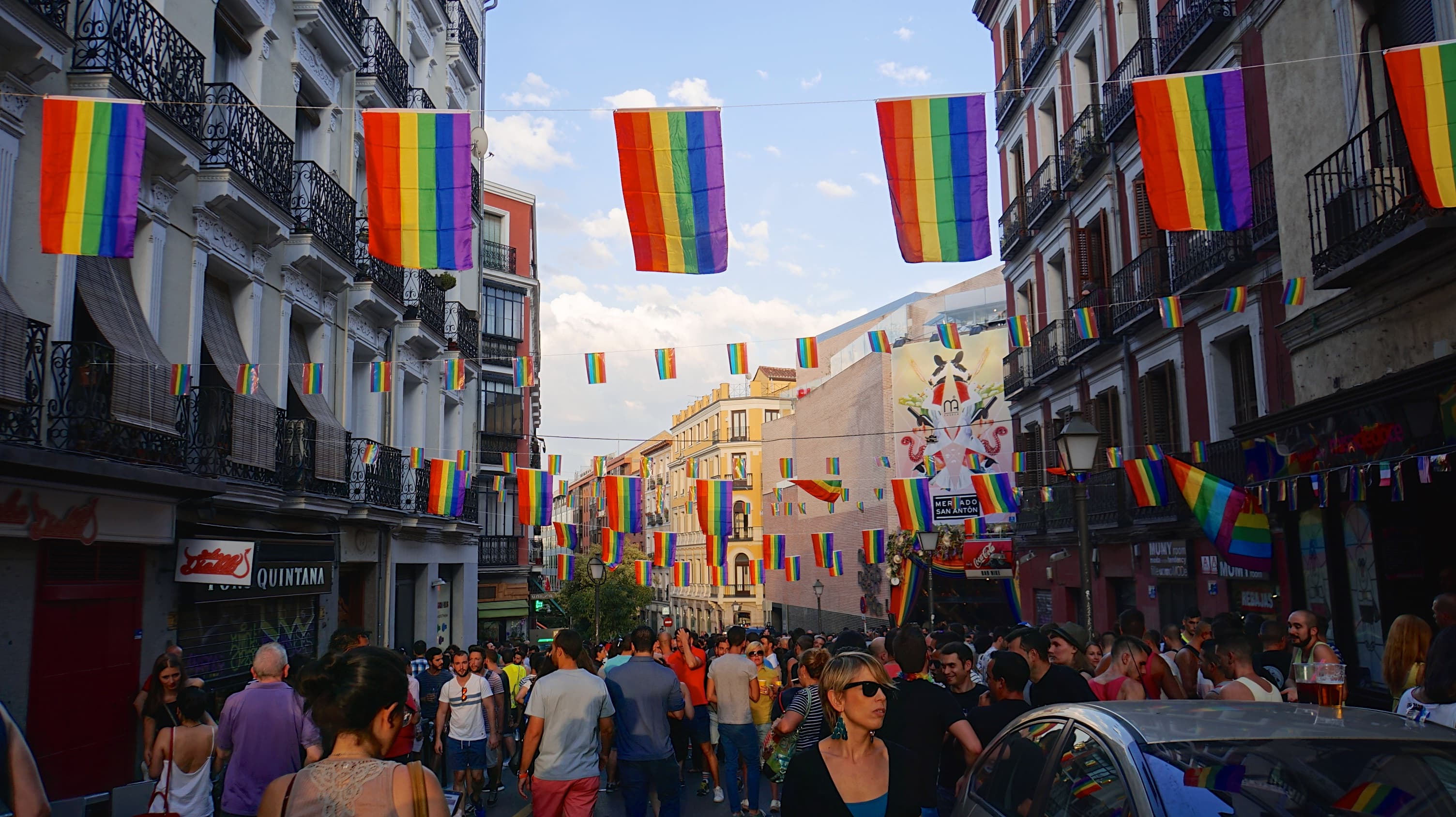
Madrid Pride is not a parade. It is roughly eleven days during which the centre of the city reorganises itself around Chueca, and you either plan for that or you spend a week confused about why your usual metro stop is locked and your street smells like spilled beer and sunscreen.
MADO 2026 - Madrid Orgullo, the official name - runs from Thursday, June 25 to Sunday, July 5. Organisers call it the largest LGBTIQ+ celebration in Europe, and the attendance numbers, regularly cited in the millions, back that up. The 2026 slogan is "A las calles con orgullo! Disidencia y resistencia" ("To the streets with pride! Dissidence and resistance"), which tells you the tone this year leans more protest than party, even if the parties are very much still on.
This guide is not the tourist version. It is the resident version: which stations close, which nights are loud, what the parade does to cross-city travel, which barrios go quiet while Chueca detonates, and what the days after look like. If you live anywhere between Atocha and Colon, read the transport section twice.
The shape of the week
Pride in Madrid is front-loaded into the neighbourhood and back-loaded into the spectacle. The early days are Chueca's own: bar events, exhibitions, and the slow build of crowds. The final long weekend is when the whole city shows up.
The dates worth marking:
- Thursday June 25 - opening. Pride kicks off in Chueca with neighbourhood activities. Crowds are real but manageable.
- Sunday June 28 - the symbolic centre. June 28 is International LGBTIQ+ Pride Day, the anniversary of Stonewall. Expect the Plumas y Patitas charity pet parade around Plaza de Pedro Zerolo and a noticeable jump in crowds.
- Wednesday July 1 - the Pregon (opening proclamation) in Plaza de Pedro Zerolo, traditionally hosted by a drag headliner. Free concerts on the main stages begin.
- Thursday July 2 - the Carrera de Tacones, the High Heel Race down Calle Pelayo. Chaotic, beloved, and a full street closure in the heart of Chueca.
- Saturday July 4 - the manifestacion, the state parade. This is the big one and the hard one. More below.
- Sunday July 5 - closing gala in Plaza de Espana and the survivors' farewell. The city exhales.
Free concerts run July 1 to 5 across the official stages: Plaza de Espana, Puerta del Sol, Plaza de Pedro Zerolo, and Plaza de las Reinas (Plaza del Rey). The 2026 line-up announced so far includes Mon Laferte, Kany Garcia, Monsieur Perine, and Flans, with more to come. These stages are where the crowds concentrate at night, which matters when you are trying to work out which streets to avoid.
The parade: what July 4 actually does to the city
The manifestacion runs on Saturday, July 4, starting at 19:00. The route is the same central spine it always is: it departs from the Plaza del Emperador Carlos V roundabout next to Atocha, climbs Paseo del Prado, crosses Cibeles, continues up Paseo de Recoletos, and ends at Plaza de Colon, where the year's manifesto is read.
Here is why that matters even if you have no interest in the parade. The Prado-Recoletos axis is one of Madrid's main north-south arteries. For most of the afternoon and evening, it is gone. So is everything feeding into it: Cibeles, the bottom of Gran Via near Alcala, and the cross streets along the route. The floats move slowly and the crowd moves slower, so the closure outlasts the parade itself by hours.
The practical translation:
- Crossing the city east-west across the centre becomes painful. The parade wall sits between Retiro/Salamanca on one side and Sol/Chueca on the other. If you need to get from, say, Ibiza to Malasana on Saturday evening, do not assume a direct route exists.
- Cibeles, Banco de Espana, and Colon are inside the storm. In recent years, Banco de Espana station has closed from the late afternoon and Colon from the evening on parade day. Recoletos (Cercanias and metro) has closed entirely.
- Buses through the centre get rerouted or suspended along the corridor. Check the EMT app rather than trusting the timetable on the pole.
If you live along the route, your building is accessible on foot but your car is trapped. Move it the night before if you need it on Sunday.
Metro closures: the part that catches everyone
This is the single most useful thing to understand about Pride, and the part newcomers learn the hard way: central metro stations close, on the busiest evenings, often with very little notice. It is a crowd-safety measure - trains keep running, but they do not stop at the overwhelmed stations, so you sail straight through.
The official 2026 mobility plan is usually published by the Ayuntamiento only a few days before Pride, so treat the following as the reliable year-on-year pattern rather than a confirmed 2026 timetable. The shape barely changes from year to year:
- Chueca (Line 5) - the ground zero closure. It typically shuts from around 18:00 until end of service across the peak stretch, roughly July 2 to 5. On the worst nights, assume Chueca is simply not a station that exists. Walk in from Gran Via, Banco de Espana, Tribunal, or Alonso Martinez instead.
- Sol (Lines 1, 2, 3) - closes from the early evening (around 18:00 to 18:30) until close on the busy days, because of the Puerta del Sol stage.
- Plaza de Espana (Lines 3, 10) - selective entrance closures across the long weekend, with fuller closures on the biggest nights for the main stage there.
- Gran Via (Lines 1, 5) - heavily reinforced and, on peak nights, subject to access restrictions.
- Banco de Espana (Line 2) and Colon (Line 4) - closures on parade day, July 4.
Reinforcement is the flip side. On the key days the central lines get extra trains: in recent years Lines 1, 2, 3, 4, 5, 6, 10 and the Opera branch all run boosted service through to closing, with extra staff drafted into Sol, Gran Via, Callao, Chueca, Tribunal, Alonso Martinez, Banco de Espana, Colon and Plaza de Espana. The trains are there. It is the specific stations that vanish.
Getting home after midnight
The good news for night owls: Madrid extends metro service for Pride. In past years the Community of Madrid has kept a central section of Line 5 running until 2:30 a.m. on the key nights to move the crowds out of Chueca, on top of reinforced night-bus service. Expect the same kind of measure for the July 3, 4 and 5 nights in 2026, but confirm the exact hours when the plan is published.
Realistic routes home from Chueca after a late one:
- Walk out of the closed-station zone first. From Chueca, the reliable move is to walk to Alonso Martinez, Tribunal, or Banco de Espana and pick up the metro there. It is five to ten minutes and it works.
- Night buses (buhos) radiate from Plaza de Cibeles and Plaza de Espana. They get reinforced for Pride, but they also fill up. Cibeles is your hub.
- Taxis and apps surge hard and struggle to reach the closed streets. A taxi cannot collect you from inside a pedestrianised crowd. Walk to a clear avenue - Paseo de Recoletos (once reopened), Alcala, or Genova - and set your pin there. Expect a wait and a premium. See our guide to taxis, Uber, Bolt and FreeNow in Madrid for which app actually works when.
- BiciMAD is often the fastest way out, but docking stations near Chueca empty fast on big nights and bikes are barred from the closed pedestrian core.
Which barrios go loud, and which go oddly quiet
Pride is intensely geographic. The noise is not spread across Madrid - it is concentrated, and the contrast is sharp.
Loud: Chueca is the epicentre and runs hot from afternoon to deep night, every night, for the full stretch. The surrounding streets - Pelayo, Gravina, Augusto Figueroa, Hortaleza, Infantas, Fuencarral's lower end - absorb the overflow. Plaza de Espana, Callao and Puerta del Sol roar on concert nights. If you live in any of these, the noise is not a rumour; it is your window until 3 or 4 a.m.
Oddly quiet: here is the local trick. Because the entire city's nightlife gravitates to the centre, the residential barrios empty out. Salamanca, the quieter parts of Chamberi, Retiro's residential streets, Arganzuela, and the outer barrios become unusually calm. Restaurants that are normally impossible on a Saturday have tables. If you want a normal night during Pride week, go the opposite direction from Chueca and the city hands it to you.
This is also the move for dinner before going out: eat in Chamberi or Salamanca, then walk or metro into the centre once you have a full stomach and a plan to get home. Our best food neighbourhoods in Madrid guide is built for exactly this kind of decision.
The 48 hours after
Pride does not end cleanly. The closing gala in Plaza de Espana is Sunday July 5, and the comedown is its own small event.
What the aftermath looks like:
- Sunday night and Monday morning the cleanup crews own the centre. Chueca's streets get power-washed; expect closed pavements, hoses, and the particular smell of a city scrubbing itself.
- Transport returns to normal fast. By Monday the station closures are lifted and the metro map is whole again. The Prado-Recoletos axis reopens once the Sunday events clear.
- The terrazas are wrecked and glorious. Bars are exhausted, stock is thin, and staff have seen things. Tip well.
- It is suddenly July. Pride is Madrid's unofficial starting gun for full summer. The week after, the city tips into heat, holidays, and the slow August emptying-out. If you have city admin to do, this is your cue - the bureaucratic shutdown is coming, and Pride is the last loud weekend before the calendar goes quiet.
The bottom line
If you want Pride, Madrid does it better than almost anywhere: free concerts on real stages, a parade that means something, and a centre handed over to celebration for a week and a half. Go on a weeknight before July 4 if you want it without the maximum crush, eat outside the centre first, and decide your route home before you leave the house.
If you just need to live here through it, the rules are simple. Saturday July 4 is the day the city splits in two along the Prado-Recoletos line - plan around it. Treat Chueca, Sol and Plaza de Espana as stations that may not exist after 18:00 on the peak nights. Walk out to Alonso Martinez or Tribunal to get home. And remember that while Chueca burns bright, the rest of Madrid is quietly having the easiest Saturday of the year.
Closures and timings here follow the consistent multi-year pattern. The Ayuntamiento publishes the exact 2026 mobility plan shortly before Pride - check madrid.es and the official MADO site for your specific night before heading out.
Main tradeoffs
- Pride is genuinely one of Madrid's best weeks if you want it, and a logistical tax on the centre if you do not. Both can be true on the same street.
- The official 2026 mobility plan is usually published only days before by the Ayuntamiento. This guide uses the consistent year-on-year pattern, but confirm exact closures on madrid.es before the worst nights.
Sources
- MADO'26 Madrid Orgullo official site / MADO / AEGAL
- Manifestacion - MADO'26 Madrid Orgullo 2026 / MADO / AEGAL
- Seis Orgullos de los que estar pendientes este mes / El Pais
- Mon Laferte, Kany Garcia y Cris Lora, entre las primeras artistas confirmadas del Orgullo de Madrid 2026 / LOS40
- Madrid Pride Orgullo 2015 image / Ted Eytan / Wikimedia Commons, CC BY-SA 2.0
- Plan de movilidad MADO 2025 Madrid Orgullo - Transporte publico / Ayuntamiento de Madrid
- Refuerzo de lineas y cierre de estaciones de Metro y Renfe por el Orgullo 2025 / Gacetin Madrid
- Cortes de trafico y estaciones cerradas por las fiestas del Orgullo / Time Out Madrid
- Metro de Madrid extends Line 5 until 2:30 a.m. for LGTBI Pride / Metro de Madrid